

Have you ever seen the letter V on a clock, in a movie title, or at the end of a king’s name and wondered, what is V in Roman numerals?
You’re not alone.
Roman numerals pop up in everyday life more than we realize. From Super Bowl numbers to chapter headings in books, they’re quietly hiding in plain sight. And at the center of it all is the simple yet powerful letter V.
So let’s break it down in the easiest way possible—no confusing math, no complicated rules. Just a friendly, clear explanation you can actually remember.
What Is V in Roman Numerals?
Let’s get straight to the point.
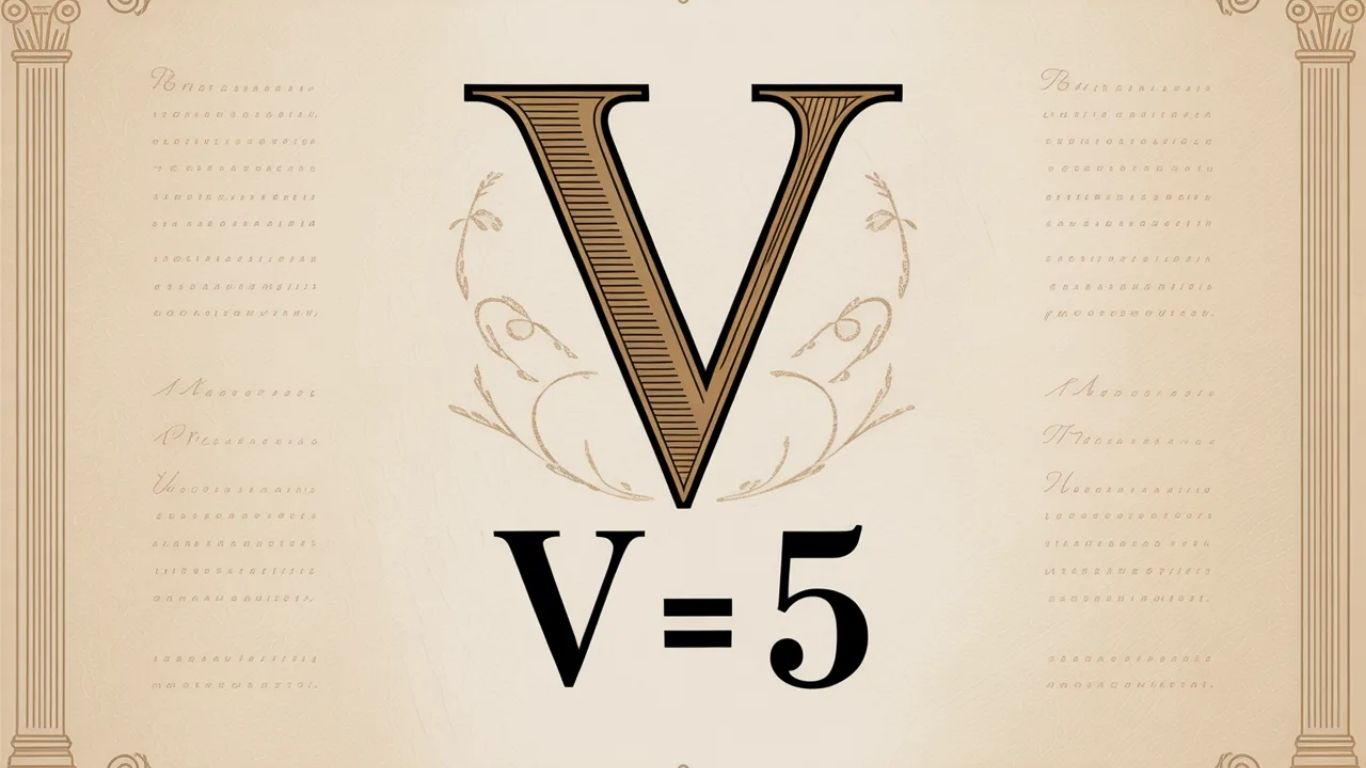
V in Roman numerals equals 5.
That’s it.
If you see the letter V standing alone in Roman numerals, it simply means the number five.
So whenever someone asks, what is V in Roman numerals, you can confidently say: It represents the number 5.
The Basic Roman Numeral System
Before we go deeper, it helps to understand the basics.
The Roman numeral system uses Latin alphabet letters to express numbers. Here are the main ones:
-
I = 1
-
V = 5
-
X = 10
-
L = 50
-
C = 100
-
D = 500
-
M = 1000
Think of them like building blocks. Each letter has a value, and you combine them to create different numbers.
Where Did Roman Numerals Come From?
Roman numerals were created in ancient Rome thousands of years ago.
The system was used for counting, trade, building, and record-keeping. Even though we now use Arabic numbers (1, 2, 3, etc.), Roman numerals have survived for centuries.
It’s like an old tradition that refuses to fade away.
Why Does V Represent 5?
You might wonder, why the letter V?
One popular explanation is that V looks like an open hand. If you spread your thumb away from your fingers, the shape kind of resembles a “V.” And how many fingers do you have on one hand? Five.
It’s a simple visual trick. Ancient systems often relied on body parts for counting.
So remembering that V equals 5 can be as easy as remembering your five fingers.
How V Works With Other Roman Numerals
Now let’s see how V behaves when combined with other numerals.
Roman numerals follow two main rules:
-
If a smaller number comes after a larger one, you add it.
-
If a smaller number comes before a larger one, you subtract it.
Here are examples involving V:
-
VI = 6 (5 + 1)
-
VII = 7 (5 + 2)
-
VIII = 8 (5 + 3)
-
IV = 4 (5 – 1)
See how it works?
V acts like a base number. You either add I’s after it or subtract I before it.
Numbers Made Using V

Let’s explore more examples:
-
V = 5
-
VI = 6
-
VII = 7
-
VIII = 8
-
IX = 9
-
XV = 15
-
XXV = 25
-
LV = 55
Once you understand that V equals 5, everything else becomes easier.
It’s like knowing the value of a $5 bill. Once you understand that, combining it with other bills becomes simple math.
Rules You Should Know About V
Here are important rules about V:
Rule 1: V Cannot Be Repeated
You will never see VV to mean 10. Instead, Romans used X for 10.
Rule 2: V Is Never Subtracted
You won’t see something like VX to mean 5 before 10. That’s incorrect.
These rules keep the system consistent and prevent confusion.
Common Mistakes With V
People often make small mistakes when writing Roman numerals.
For example:
-
Writing IIII instead of IV for 4 (though some clocks still use IIII)
-
Writing VV for 10 (incorrect)
Remember: Roman numerals are structured and rule-based.
V on Clocks and Watches
Have you ever looked at a classic clock face?
Instead of numbers 1 through 12, you see Roman numerals.
At the 5 position, you’ll see V.
Interestingly, many clocks show 4 as IIII instead of IV. This is done for visual balance.
But 5 is always V.
V in Movies, Sports, and Names
Roman numerals are still widely used today.
Movies
Sequels often use Roman numerals, like:
-
Rocky V
-
Fast & Furious V
Sports
The Super Bowl uses Roman numerals to number games.
Royal Names
Kings and queens use Roman numerals, like:
-
Henry V
-
Louis XVI
Whenever you see V in these contexts, it means 5.
Comparing Roman Numerals to Modern Numbers
Modern numbers are place-value based. Roman numerals are not.
For example:
-
5 is simply V.
-
15 is XV (10 + 5).
Roman numerals are more like stacking blocks than building with digits.
They’re less efficient for large math but still elegant and symbolic.
Why Roman Numerals Still Matter

You might ask, why are we still using them?
Because they represent tradition, style, and history.
They’re used in:
-
Book chapters
-
Movie sequels
-
Monument engravings
-
Clock faces
They add a classic feel, like wearing a vintage watch in a digital world.
Fun Facts About V
Here are some interesting facts:
-
V has always meant 5 in Roman numerals.
-
The Roman numeral system has no zero.
-
Large numbers required long combinations of letters.
-
Roman numerals are still taught in schools worldwide.
Simple system, lasting impact.
How to Easily Remember What V Means
Here’s the easiest way:
Think of your hand. Five fingers. Shape of a V.
That mental image sticks.
So next time someone asks, what is V in Roman numerals, you won’t even hesitate.
It’s five. Just like the fingers on your hand.
Conclusion
So now you know the clear answer to the question: what is V in Roman numerals?
It represents the number 5—simple, timeless, and still relevant today.
From ancient Rome to modern movie titles, V has stood the test of time. It may be just one letter, but it carries thousands of years of history behind it.
And honestly? That’s pretty impressive for something so small.
Frequently Asked Questions (FAQs)
1. What is V in Roman numerals?
V represents the number 5 in Roman numerals.
2. Why does V equal 5?
It likely represents the shape of an open hand, which has five fingers.
3. Can V be repeated in Roman numerals?
No, V cannot be repeated. Instead of VV for 10, Romans used X.
4. What does IV mean?
IV equals 4 because I (1) comes before V (5), meaning 5 minus 1.
5. Where are Roman numerals used today?
They are used in clocks, movie sequels, royal names, sports events, and book chapters.
For More Visit: Thecelebrities


